
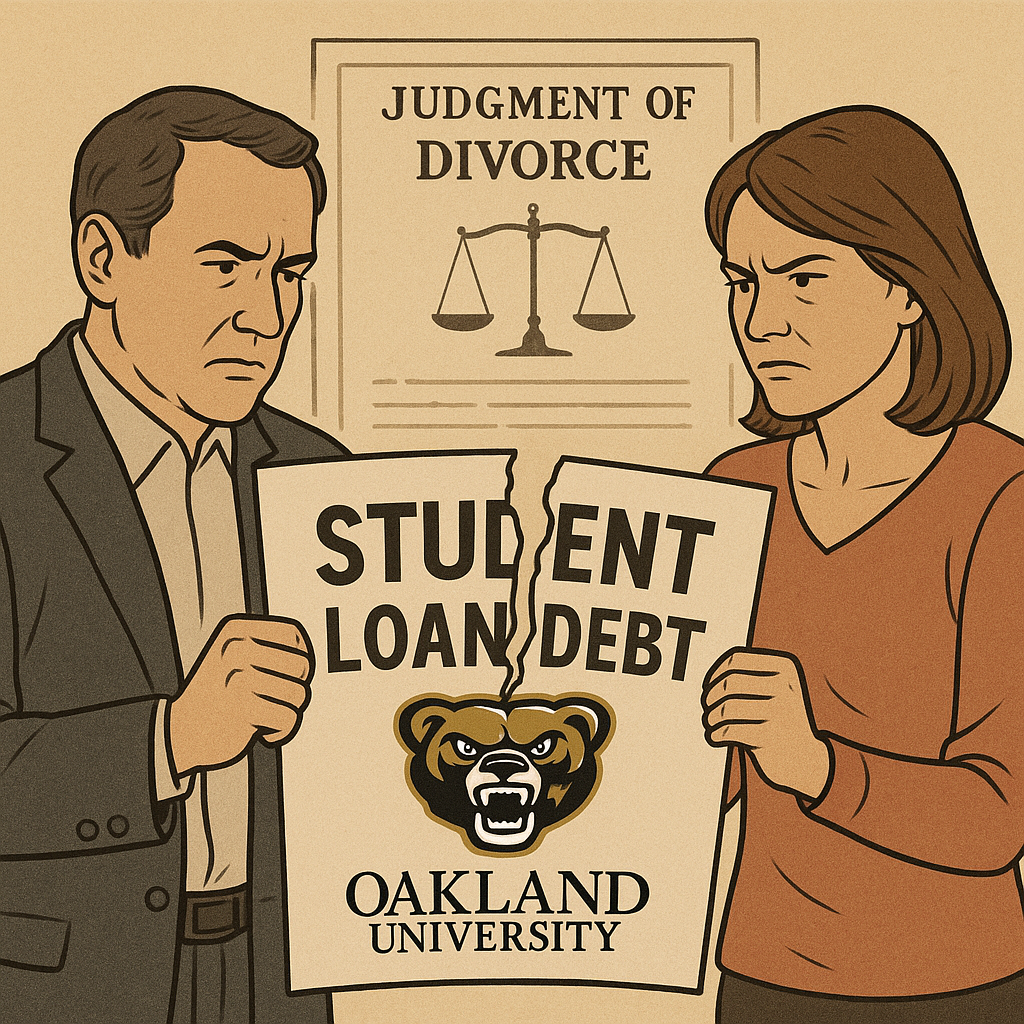
With the rising costs of higher education, it’s no surprise that many Michiganders bring tens of thousands of dollars in student loan debt into the marriage or run up student loan debt during the marriage. Divorce often raises difficult financial questions, and in Oakland County divorces, student loan debt is one of the most common issues that couples face. This isn’t unique to Oakland County; in fact, it’s common in Livingston County and Macomb County, too.
So, how is this debt handled when a marriage ends? Michigan law gives guidance, but the answers depend heavily on the individual facts of each case.
Michigan’s Legal Framework on Debt Division
Michigan is an equitable distribution state, which means marital property and marital debt are divided fairly between spouses. The division is not necessarily 50/50. Our Oakland County judges consider the circumstances of each case based on factors called the Sparks Factors. These include, but are not limited to, the duration of the marriage; the parties’ contributions to the marital estate; the parties’ necessities and circumstances; and the parties’ earning abilities.
Marital property is generally “all property that came to either party by reason of the marriage.” This includes assets such as homes, vehicles, and retirement accounts. It also includes debts such as credit cards, loans, and student loans.
Student loans don’t always fit neatly into “marital” versus “separate” categories. Courts distinguish between:
- Loans incurred before marriage: Generally remain the responsibility of the spouse who took them out.
- Loans incurred during marriage for one spouse’s education: Courts look closely at whether the marriage benefited. If the education increased earning capacity and the family relied on that income, an Oakland County Circuit Court judge may treat some or all of the loan as marital debt.
- Loans incurred during marriage that benefited the household: If loan proceeds were used to pay household bills, support the family, or cover joint expenses, an Oakland County Circuit Court judge may treat some or all of the loan as marital debt.
Michigan Precedence on Student Loans in Divorce
Michigan appellate courts have repeatedly emphasized that student loans are not automatically considered marital or separate. The Michigan Court of Appeals has noted that debts should be divided in the same way as assets. When the loan proceeds were used to pay marital bills, buy groceries, etc., the Court has upheld decisions requiring both spouses to share responsibility for student loans taken out during the marriage. On the other hand, Michigan courts will assign sole responsibility of the debt to the spouse who took out the loan when the degree primarily benefits that spouse.
The main takeaway? Outcomes are fact-specific, and Oakland County family court judges exercise broad discretion when deciding how to divide student loan debts in divorces, if at all. After representing clients for more than 30 years, the vast majority of student loan debt is the responsibility of the spouse who borrowed the money.
Oakland County Divorce Courts: What to Expect
Oakland County Circuit Court judges apply the same equitable distribution principles as other Circuit Courts throughout Michigan. As already mentioned, these decisions rely heavily on the facts of each case. So, the outcomes may vary based on the answers to these types of questions:
- When was the loan taken out?
- How were the funds used?
- Did the marriage benefit from the education?
- What is each spouse earning?
- Does each spouse have the ability to repay?
Because student loan debt can be substantial, being assigned even a small portion of the debt can affect your financial future for decades. Hiring an experienced family law attorney who is familiar with Oakland County family court judges can improve your odds.
Why You Should Hire a Skilled Attorney
Student loan debt allocation in divorce is not always straightforward. Unlike the division of other marital property, student loan debt requires nuanced legal arguments, knowledge of Michigan case law, and a strong presentation of evidence. Without proper legal representation, you risk owing money that you should not be responsible for or losing out on protections the law allows. A skilled Oakland County divorce attorney can:
- Argue whether the debt should be considered marital or separate
- Gather and present evidence about how the loan did or did not benefit the marriage
- Advocate for a fair allocation based on your circumstances
- Protect your financial stability
FAQs: Student Loan Debt and Michigan Divorce
Q: Does Michigan law automatically split student loans 50/50 in divorce?
No. Michigan family law courts divide debts equitably, not necessarily equally. Courts divide debt based on the specific facts of each case, focusing on when a spouse incurred the debt and how the parties used the funds.
Q: What if I co-signed my spouse’s student loans?
If you co-signed, you are contractually liable to the lender regardless of the divorce outcome. Your attorney can, however, negotiate reimbursement through property division or spousal support.
Q: If the loan was taken out before the marriage, can it still be divided?
Generally, no. Michigan courts treat loans that a spouse incurred before the marriage as separate debt. But the loan may affect your overall property division. You should consult with your attorney to get a better understanding of whether this may affect your case. In addition, Michigan’s family court judges do have the authority to “invade separate assets” and require the non-borrowing spouse to pay some or all of the other spouse’s student loan debt under certain circumstances.
Q: What if loan money was used for household expenses?
If a spouse used student loan funds to pay for family expenses like rent, groceries, or utilities, the court is more likely to treat that debt as marital and divide it between both spouses.
Q: Can student loan debt affect spousal support in Michigan?
Yes. Courts may consider student loan obligations when determining ability to pay or need for alimony under the Sparks factors.
Contact our Family Law Attorneys!
In Oakland County, dividing debt during divorce can be just as complex—and often more contentious—than dividing assets. Michigan law gives family court judges broad discretion to reach a fair result based on the facts of each case. That means how and when a debt was incurred truly matters.
At The Kronzek Firm, we represent clients throughout Oakland County and nearby counties such as Livingston, Macomb, and Jackson. We work with you to gather and present clear evidence showing which debts are separate and which should be shared. Our goal is to protect you from unfair debt allocation, including responsibility for student loans or other obligations that are not truly yours.
An experienced, aggressive divorce attorney can help safeguard your financial future. Contact us today to schedule a consultation, or email contactus@kronzek.law anytime.
📞 Our highly respected attorneys have fought for thousands of Michigan clients for more than 30 years. You can reach our Farmington Hills office 24/7 by calling (248) 479-6200.
[Disclaimer: This content is for informational purposes only and does not constitute legal advice. Consult an attorney for personalized guidance.]